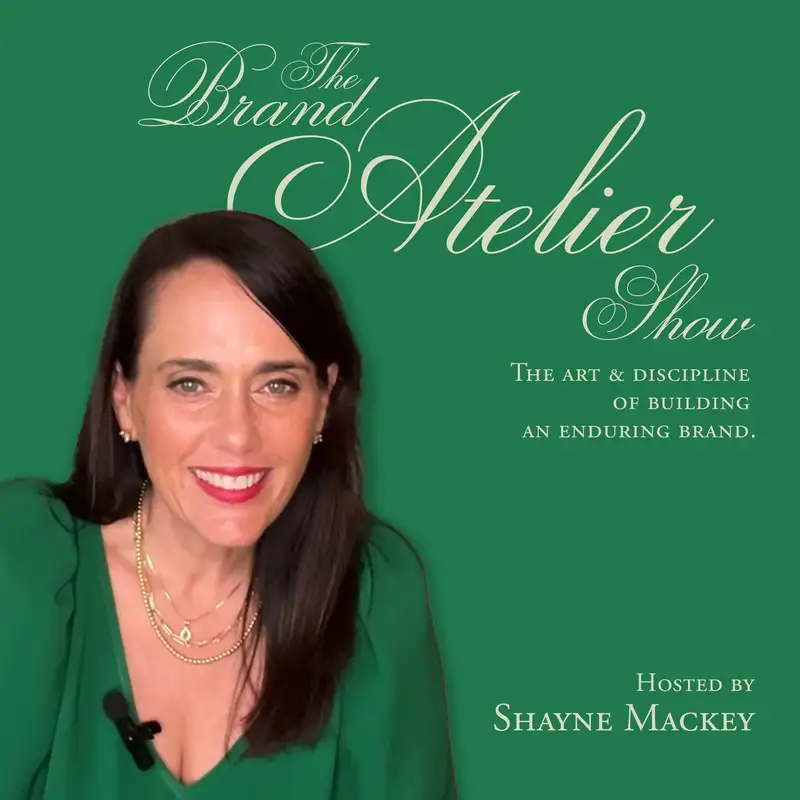
Ogilvy: What Happens When the Expert Brand Outlives Its Founder
Hi, I'm Shayne Mackey. Welcome back to the Brand Atelier.
I have loved David Ogilvy my entire career. Not in a casual way.
In the way you love someone who changed how you think, whose books you have read more than once, whose ideas show up in your own work so regularly that sometimes you forget where they came from. Ogilvy on Advertising, Confessions of an Advertising Man. If you have not read them, stop this episode right now and go read them. I will be here when you get back. Today, we're going inside the Ogilvy brand. Not just David Ogilvy the man.
The firm he built, what he built on, and what happened when it had to survive without him.
Because that is the real expert brand question. Not can you build something great, but can what you build outlast you?
David Ogilvy was born in England in nineteen eleven. He left Oxford without a degree. He worked as a chef in Paris, a stove salesman in Scotland, a farmer in Pennsylvania Amish Country, and a British intelligence officer in Washington during World War II. In 1948 at the age of thirty seven, he started an advertising agency in New York with $6,000 and two clients.
Within fifteen years, Ogilvy and Mather was one of the most respected agencies in the world. Not because of scale, because of thinking. David Ogilvy had a philosophy about advertising so clear and specific and so rigorously applied that it became the architecture of everything the firm produced. Research first, always. The consumer is not a moron, she is your wife.
You do not build a brand by insulting the intelligence of the person you are trying to reach. The big idea, not a tagline, not a slogan. A single idea, so powerful it could anchor a campaign for decades. Dove was positioned as one quarter moisturizing cream. That positioning, unchanged, ran for 30 years. By 2025,
The brand built on that original insight was worth seven and a half billion dollars. Results over awards. In the modern world of business, it is useless to be a creative original thinker unless you can also sell what you create. Ogilvy said that, and he meant it. Every piece of work had to move a product. That is the expert brand at its purest.
A methodology so distinctive, so rigorously applied, so consistently demonstrated to work that the market came to trust the name before they ever met the person behind it. The thinking traveled, and that is the whole definition.
What made Ogilvy remarkable is how deliberate David protected the methodology as the firm grew. He called it the true church. Not a polite aspiration, a standard, an expectation, a line that the either that either the work met or it did not.
He was famously worried as the firm acquired other agencies through the nineteen seventies. Not because growth was bad, but because he knew that every agency they absorbed came with its own philosophy, its own way of working, its own definition of what good looked like. And he knew that dilution was the expert brand's enemy.
He moved to his friend Chateau in 1973. He stepped back from day-to-day management, but he never stopped being the standard. His books were the standard. His memos were the standard. His voice, even when he was not in the room, was the standard. That is what a founder does for an expert brand when it's working. Not manage, embody. Hold the line. Make the standard visible by existing.
And then in 1989, WPP acquired the firm in a hostile takeover. David Ogilvy called Martin Sorrell, the WPP founder, an odious little jerk. He did not want to be acquired. He understood what acquisition meant for a firm whose value lived in its independence, its culture, and its methodology. He understood that becoming part of a holding company was an architectural shift.
Not a financial one. He was right, and he was also powerless to stop it.
WPP paid $864 million for Ogilvy in 1989. That price was paid for the brand, the reputation, the client relationships, the methodology, to the extent it could be transferred. What it could not buy was David Ogilvy's presence as the living embodiment of the standard. He became non executive chairman of WPP. He stepped down three years later.
He retired to his chateau and he died in 1999 at the age of 87. And the firm had to figure out how to be Ogilvy without Ogilvy. That is the expert brand's hardest problem. Not building the methodology, protecting it at scale across 25,000 people, across 83 countries.
Across decades of leadership transitions and holding company pressures and industry disruptions. By 2018, the firm's own CEO, John Seifert, said it publicly:
In their pursuit of growth, adding capabilities, acquiring entities, they had become a mini-holding company. The Ogilvy brand was being diminished. The CEO of Ogilvy said publicly that the Ogilvy brand was being diminished. That is the dilution traps. Not a sudden collapse, a slow drift. Year after year of saying yes to growth, yes to new capabilities.
Yes to the holding company's consolidation agenda until one day the people inside the firm could no longer say with precision what made Ogilvy different from any other network agency. That is what happens when the expert brand loses the thread.
Here is what makes the Ogilvy story ultimately instructive rather than just cautionary. They named the problem and they went back to the source. Seifert's restructuring plan, which we he called Ogilvy's next chapter, was explicit about what had happened.
They had drifted from the values, principles, and ways of thinking that David Ogilvy built. The mission was not to invent something new, it was to go back. Back to what David actually built. Back to the methodology, back to the founding clarity of what made Ogilvy Ogilvy. Make brands matter. That is the mission statement they landed on. The language is new. The principle is David Ogilvy's founding principle, unchanged.
And it worked. Ogilvy is still Ogilvy. JWT is gone. Young and Rubincam is gone. Gray has been absorbed. Ogilvy survived because at its critical moment, someone in leadership looked at what they had built and said, This is not who we are. And they had enough of David's original thinking encoded in the culture to know what to go back to.
The Dove campaign won the Creative Strategy Grand Prix at Cannes in 2025, more than 25 years after David Ogilvy had died. Built on positioning he wrote in the 1950s. Still working, still compounding.
That is the expert brand at its most durable when the thinking is so solid, so precisely constructed, so genuinely true about product and the consumer that it outlives everyone who created it.
First, the expert brand's methodology has to be written down. David Ogilvy wrote everything, the books, the memos, the magic lanterns, which is what he called the internal training presentations he built to transmit the standard to every person in the firm. He understood that the methodology could not live only in his head. It had to be externalized, teachable, held in documents and culture and training that survived his departure.
Most expert brand founders never do this work. They believe the standard is obvious because it is obvious to them. It is not obvious to the twenty-five thousand people who join the firm after them.
Second, scale is the expert brand's greatest threat and its greatest opportunity. Ogilvy scaled brilliantly for decades because David held the standard personally. When he could no longer hold it personally, the standard needed to live in systems, culture, and leadership that carried it forward. The firm lost that for a period. The fact that they found it again is the lesson.
Third, the founding clarity is always worth going back to. When Ogilvy got lost, the answer was not a new strategy. It was not reinvention. It was David's original strategy, reread, reunderstood, and recommitted to. The expert brand that can return to its founding principle when it drifts has an anchor that pure scale businesses will never have.
What would David say? That is a question Ogilvy people still ask. That is the standard still operating fifty years after he stepped back. That is what it looks like when an expert brand methodology is built to last.
We've gone through two case studies now, IDEO and Ogilvy. Two expert brands, two different failure modes, two very different outcomes. Next time, I want to give you my take, what I have learned in 32 years watching expert brands succeed and fail. And the one thing I believe every expert brand has to protect above everything else. And I will tell you something I do not say out loud on the show very often.
The questions I ask my clients about their expert brands are the same questions I am asking myself right now about my own.
One more thing before I go. If this brand made you think, I want to stay in touch. The link to download my four pillars of brand architecture white paper is right in the show notes. It maps the four brand architecture types operating in today's market. It's free, and I'd love for you to have it. I'll see you here next week. I'm Shayne Mackey. This is the Brand Atelier, and we're here to build something that lasts.